








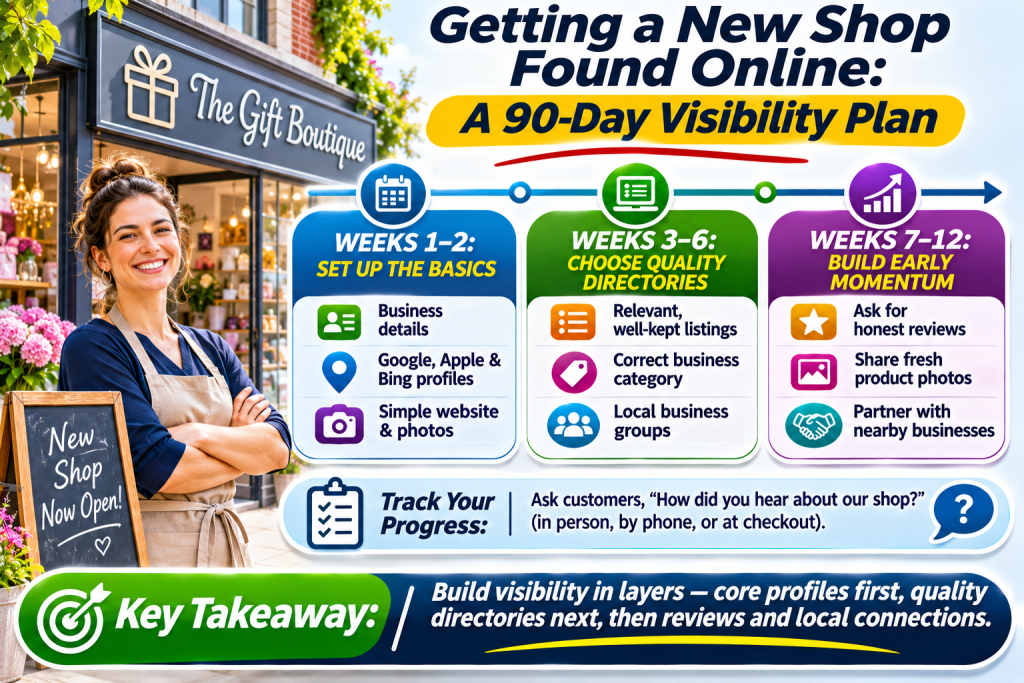
Quick Answer: A new business builds online visibility in layers: first the core profiles, then a few relevant, well-maintained directories, then reviews and local connections. Doing it in order keeps your information consistent from day one.
A new gift boutique opens on Main Street with a fresh sign and a full display window. Walk-in traffic is decent, but when a neighbor searches “gift shop near me” from two blocks away, the boutique does not appear. That is normal for a new business. It has no reviews, no listings and no online history yet. The good news is that a few focused weeks can change that.
Weeks 1 to 2: Set Up the Basics
Before you list anywhere, write down your official business information: exact name, address, phone number, website, hours and a two-sentence description. This becomes the master copy for every profile.
Then claim the core platforms. Create and verify your Google Business Profile, add your shop to Apple Business Connect and Bing Places, and reserve matching social media handles. Even a simple one-page website with your hours, location and photos gives every other listing something to point to. Take a few clear photos of your storefront and interior now, because you will reuse them on almost every profile.
Weeks 3 to 6: Choose Quality Directories
New owners are often tempted by services that promise hundreds of listings at once. A handful of relevant, well-kept directories is a better start. Look for directories with clear categories, real business profiles and visible editorial standards, and skip sites full of spam or broken pages.
Category matters as much as the directory itself. A retail shop listed in HaHa Directory’s Shopping and Sales category sits where local shoppers browse for stores, not buried in an unrelated section. Add your local chamber of commerce and any downtown business association too.
Weeks 7 to 12: Build Early Momentum
Now focus on signals that only time and customers can create:
- Ask your first happy customers for honest reviews
- Post fresh photos of new products and seasonal displays
- Partner with nearby businesses on events or cross-promotions
- Ask new customers at checkout how they heard about you
That last step tells you which listings and channels are actually working, so you can spend time where it pays off.
Build in Layers, Not All at Once
Visibility for a new business grows step by step: core profiles first, quality directories next, then reviews and community connections. Keep every listing matched to your master record, including your HaHa Directory profile, and revisit the plan at the 90-day mark. You will not appear everywhere overnight, but you will be building on a clean, consistent foundation.
Frequently Asked Questions
Do I need a website if I already have social media pages?
A website is strongly recommended. Social platforms can change their rules or limit who sees your posts, while your website is a home base you control. It does not need to be elaborate. A single page with your hours, address, phone number, photos and a short description gives listings and customers a reliable place to confirm your details.
How many directories should a new business join?
There is no ideal number. Start with the major platforms, then add a small group of directories that are relevant to your industry or town and that you can keep updated. Quality and accuracy matter more than volume. Ten correct listings are more useful than fifty abandoned ones with outdated information.
How soon will a new business appear in local search results?
Timing varies. A verified Google Business Profile can appear within days, but showing up for competitive searches usually takes longer, because reviews, history and other signals build gradually. Search results also depend on where the person is searching from and what they type, so no one can promise a specific timeline.
Should I list my home address if I run the business from home?
Usually not, if customers do not visit you. Google Business Profile lets service-area businesses hide their street address and show the areas they serve instead. On directories, use the same approach where possible. Never invent a storefront address or use a virtual office that breaks a platform's rules, because that can get listings suspended.